Back to school: What about summer school

Why I hate year-round school, and what’s the alternative?

I really like having summer for kids. Each year, I see the growth. A growth made possible because of the rites of passage as summer both begins and ends. Just this week, I see them interacting with their school buddies after they switched to interacting with their neighborhood, summer camp, summer school, or other non-school friends.

Could they have similar rites of passage without the traditional American summer? Maybe, but not so fast. I mean, France has “Les grandes vacances”, the summer holiday or August Vacation, and many countries have something similar. Why re-invent the wheel?

Trimester? 15 weeks x3 45 weeks? With 7 weeks of break?
Quarters? 4 11-week sessions? With 8 weeks of break?

Or, how about returning to the tried and true?
Give the national and generational shared experience of a school year & summer that uses Labor Day and Memorial Day as their encapsulation boundaries.

Summer is Memorial day to Labor day!!! Yay!
School is Labor Day to Memorial day!!! Oh My!

Now, the negatives….

We require more days of education, and that eliminates those days. Let’s assess that loss. Most states require 180 days per year. There are two issues:

The number of weeks between January 2 and Memorial Day is ~21, and between Labor Day and the Winter Solstice is ~17. That’s a 4-week difference. We do lose a week (5 days) in the spring for spring break, and only 3 days in the fall for Thanksgiving break. We also tend to have more holidays in the spring. Let’s reduce that to 19 weeks in the spring. That gives us a 2-week difference; 17 + 19 at 5 days a week gives us exactly 180 days.

Now, what about unscheduled days off, other holidays, and in-service days? That would leave us with less than the required 180 days. Let’s make up for that with a summer intersession. Why else might we want a summer intersession?

With Summer’s off, there are 3 issues people raise:

  • Students lose too much knowledge
  • Parents need to work
  • Kids become delinquents

I have issues with all three.

A: Knowledge Loss: Let’s have a summer session and summer homework to address the knowledge loss. If someone struggles, they can have a longer set of summer classes.

B: Parents need to work: This applies mostly to younger or high-maintenance students. Programs can be developed or offered for these groups. Summer school, summer camps, etc. Some would argue that they are supplementing the poor! Well, what did you expect? You/we are not paying them a living wage to purchase summer care or have a one-income household/stay at home parent; otherwise, you complain they are a welfare family. We can’t have it both ways. We need work that pays a living wage. Check out how our taxes are paying for many companies’ low wages. i.e., Walmart, a company that’s undercutting our small business owners’ prices only to underpay employees; and many fast food companies. All of which rely on employees getting supplemental income through Medicaid, Food Stamps, and Housing Support, among other services. Either way, can we offer year-round classes/programs to youth under 11 years of age? At what age have youth traditionally been able to start staying home on their own. That was the age the Red Cross offered babysitting classes to. Granted, at 11, the general rule was that they could do only a 2-hour continuous babysitting session, which increased as they aged.

C: Kids being delinquents: Kids can be delinquents during the school year just as easily. If you want to rein them in by losing the privilege of a summer break, or by having a more limited summer break, or otherwise adding more structure, so be it. They can have more days of summer school. There are plenty of options.

On to the summer intersession option

Let’s start with my preferred option: a 2-week intersession.

Why?

First, this adds 10 days to the school year. That means instead of a tight 180 days, you now have 190 days to play with.

Second, it brings learning and potentially a reduction in knowledge loss over the summer.

Third, it allows for a unifying, shared national summer experience from Memorial Day to Labor Day. This 12-week summer break will hopefully bring people together and add shared nostalgia.

This 3-month break allows teachers to take a 12-week summer break, which is one reason many teachers choose to teach. After all, we already have a teacher shortage; why make it harder to get teachers? An easy option that doesn’t add strain to tight school systems and state budgets.

This also allows some teachers to continue working over the summer. For grades 6-12, this means an ~85% reduction in the workforce.

Other options

Wait, didn’t you say six summer sessions? Isn’t that only an 83% reduction in utilization? Yes and no! Not all students are required to us a school sponsored summer program. They can qualify for many other APPROVED programs.

Approved programs?

Yes, summer camps, Vacation Bible School, a week at the Smithsonian, or other approved educational opportunities paired with summer reading, along with reports and tests/skill/knowledge verification systems. Other opportunities can be parks like Joshua Tree, Yosemite, Yellowstone, or local nature centers. These on their own may not be enough, but paired together, they may qualify as a replacement for the school’s summer program.

They all require thinking, reading, writing, research, etc. Take a look at camps; if it’s nature-based, they can have specific educational aspects; if it’s space camp, math camp, maybe a debate camp or similar, these are all highly thought-based and help keep the student’s engaged thereby reducing knowledge loss.

Plus?

Each district can have some specific requirements for all students. Maybe everyone needs some reading & writing, a little math, and some research outside of those programs. After all, if one argues that there is knowledge loss in the summer, an early or late 2-week session leads to 10 other weeks of loss. You can assign these each month to spread out the learning. These would continue lessons from the previous year while preparing the student for the upcoming school year.

Conclusion

A:

I love seeing the youth grow each year as they experience the rites of passage, milestones, and coming-of-age experiences each year brings. A summer transition brings not just new milestones, but new beginnings you don’t typically notice in a simple transition from one grade to the next. A simple ceremony is not enough. Ending a school year gives you that “I’m now a year older” feeling, but beginning a new year brings the knuckle-down phase. You grow over the summer, and things become formal when the new year starts. It’s like a butterfly; a reset where you “shed off the old”!

I love the new freedoms I see people explore each summer & the fresh new things they get to start the new year in the fall as they begin fresh, often forging new friendships and growing in each phase.

B:

Final Conclusion, let’s unify the country with the shared experience of a common Memorial Day to Labor Day summer while not losing educational knowledge

P.S. What about that ODD extra two-week period we see in the spring semester?

Maybe we should have a 2-week winter intersession too? A single 2-week; it’s now a new calendar year. Maybe have short projects. A math club intensive, a book report week. Shop class project, try xyz out as we take a two-week sabbatical to get ready to knuckle down for the spring.

The same thing for spring vs fall today! Why are we going into June vs. starting in August?

I definitely prefer keeping the winter break as the separator between semesters. This is even true today. I HATE HATE HATE schools going into June. If you need an extra couple of weeks to ensure 180 days in the school year, add them to the fall semester, which is already 2 weeks shorter. After all, by mid august, they are anxious and ready to begin a fresh new year, while expecting them to return and knuckle down for two weeks after the long Memorial Day holiday weekend is hard. It almost becomes a useless 2 weeks, whereas in the fall, they are ready to learn or at least can use the 2 weeks to transition back into the routine of the school year.

Back to the question of year round school…

What would we do: Quarters or trimesters?

With 180 days, we’re looking at 36 five-day weeks, plus two for buffer, that’s 38 weeks. Would we increase that more? We have 12 weeks in the summer, but as we noted, most districts use a couple of weeks in June or August to reach the required 180 days. (17+ 19 weeks = 36 weeks confirms that’s the current reasoning) Thus, let’s reduce that 12-week summer by 4 weeks to allow for some transition breaks. We’re now at 8 weeks in the summer.

We just assumed a couple of things

We just added 8 weeks of education. That’s 230 vs. 190 of the current 180-day requirement.

Undoing that assumption…

Should we switch to a 4-day week? Missouri has done that and added 45 minutes to the school day. With the 46 weeks above, if we opt for a 4-day week, we would have 184 of the 180 days currently required. That allows us to make up lost days by adding some Mondays to the schedule.

Ok, now how to break it down

46 weeks in 3 parts. . . That is 3 fifteen-week sessions. Ok, that’s 15.3333 weeks; round that down and give us an extra vacation week somewhere. Summer, winter, fall- it doesn’t matter. Between sessions or mid-session, that’s up to the district. I can’t say what’s better here. I do know that 3 15-week sessions bring us back down to 225 days from 230 or exactly 180 days with a 4-day week.

Let’s say 46 weeks in 4 parts instead. This gives us 4 eleven-week sessions. Ok, technically 11.5-week sessions. Using this method, we can break it down to 11 weeks and add two weeks of vacation, which gives us 44 weeks in a year. That means ~220 days of a 180-day requirement. We can add plenty of mid-semester breaks and stay in compliance. 44 weeks in a year gives us 8 weeks off, less than our current 12-week summer break, along with the fall, spring, and Christmas/winter breaks.

Finally, how about 4 ten-week sessions? This gives nice round numbers. Each quarter has an obvious 5-week midpoint. With the current 38-week year, quarters are typically about 9 weeks in length, very similar to the 10 weeks proposed here. This means a 200-day year. With about 12 weeks off scattered around the year. 2 weeks between each session is 8 weeks; add a mid-session break, and you’re at 12 weeks. A district might break it down with several 4-day weeks. You can keep the 12 break weeks and still have several 4-day weeks if you keep the 180-day requirement. But then you run into challenges with those breaks… Check them out below.

The major challenge vs the benefit: Those pseudo-random breaks

Ok, they are not random. They come between terms, and maybe mid-term, but while they have benefits, they come with challenges too.

This spreading out of breaks definitely minimizes knowledge loss, but it makes it harder for parents who need child assistance. A single summer block has an industry built around it. They have weeks of daycare, summer school, or camps. Many of these, as noted, can already minimize knowledge loss if requirements were in place.

Spreading these out may also add challenges to the travel industry. With more standard short breaks, people will travel in those smaller windows, making parks, camps, and travel options bipolar in use. During the breaks, they will be inundated with business, and devoid of business in the off weeks. With seasons, you have consecutive blocks where employees can work there and, conversely, work elsewhere in the “Off-Season.” Camp counselors can be senior campers/high schoolers working during their own 12-week summer vacation vs. being pulled in cold for various off-school weeks.

Posted in Uncategorized | Leave a comment

Feminism’s Evolution: From University Voices to Personal Choices

Discussing:

Article: Universities have destroyed feminism; Student activists have never understood sex
By Julie Bindel Jun 4 2021

Discussion

Multiple cohabiting clouds of feminism exist. Not “levels” or a spectrum; one is not over or better than another. They are not separate. They can overlap.

First, anyone who supports a woman (“female” >> feminism {1})  or women’s rights, values, products, et al is a feminist.   

Second, some must overshoot the goal. Remember to shoot for the moon, and even if you miss, you’ll land among the stars. {2} You ask for more, and you fight harder than you should have to. This gives you room to compromise. These feminists are the heroes of the movements, but also the hated and occasionally embarrassing ones. Yet, years later, we can look back at them with pride. These compromises are small steps. {3, 4}

University Feminists in the mid-to-late 20th century were among the prominent and progressive feminists. Obviously, that gave them more voice. (Gradual progress from early 19th century to Late 20th) Yes, two forks, same focus. The second being the working-class women. Again, many crossovers. Plenty of “University Women” worked alongside non-university women, and fed off each other. University clubs helped. 

Universities have traditionally been about progressive thinking, open minds. Yes, that progressiveness often met resistance that demanded respect; that resistance frequently came from within the universities too.    

1: AUTISM: I’ve made the mistake of being too clinical, too PC. Females /= Women. THAT’S TOO COLD, THAT’S NOT US. Yes, even when using the term feminism, you don’t use females. That gender vs sex question still plays into things. Both the gender and sex arenas have an iron in the feminism fire. A trans woman is a woman; let them join the fight. A trans man was assigned female, and as a woman, or a male trapped in a woman’s body (AFAB), had to fight the restrictions to become the man they are. Yes, often those fights are ongoing. 

2:  Yes, you can’t just accept anything. Like the moon, you don’t want to end up in the void of the asteroid belt. However, many feminists have fallen on the sword to make progress for a movement others have benefited from. 

3: Small steps; major changes raise walls of resistance. Yes, it’s an ugly fight, and many of the over-shooters hate the idea that people make compromises.

4: (((THERE’s a WHOLE BOOK on the need for hyper extreme efforts. a book specifically about feminism. I CAN NOT REMEMBER ITS NAME. Feel free to mention it.)))

p.s. This article was written in 2021, yet it discusses experiences from before 2000 rather than contemporary notes on the changes. It leads you to the water, where you can ponder the points of the last dozen years or more. Is that from today, 2014-2026, 2021, or earlier? As Tim Wise pointed out: We never lost our racism, or in this case, sexism. (Tim Wise https://en.wikipedia.org/wiki/Tim_Wise )

Instead, it’s also a discussion more on patriarchal sex, porn, and male erotic dreams. No, not the traditional Missionary sex position, but the oppressive women’s pain and humiliation and the related money. This vs the woman’s right to do this work or things SW, BDSM, Traditional Wife lifestyles.

It’s a discussion of the conflict between two feminist storm clouds. The freedom of women to use their feminism to make money off of or enjoy these male _____ (Fantasies?) of women and sex. The freedom to control men? The freedom of equality?

What about the responsibilities that come with these freedoms?

I’ll bring this to two topics. BDSM & later, TRAD Wifes.

We have had plenty of women who have entered into consensual BDSM relationships. The key there is “Consensual.” Julie does not explicitly say BDSM. Her use of pain and humiliation can just as easily apply to adult dancing and the traditional 50s housewife lifestyle. BDSM has become much more mainstream between her 1989 date and her 2021article. “TRAD” has also become very prominent in the 6 years before the article’s publication.

Again, consent must be a part of the discussion. How can one freely consent if one was raised (Groomed by society) to be submissive to men? The thing is, the children of feminists have a significant rate of consent. Granted (without quoting statistics), experience has shown me that there are plenty of submissive men.

Now, the controversial part I’d love to see articles and papers on:

A: That experience has also shown me that women tend to get more dominant over time. I would say men less so. There seems to be a split. Probably a fairly equal split between women who have become more dominant and those who haven’t.

B: I believe there is at least some point of rebellion going on. Like with the children of the super conservative – the sheriff’s kid or the preacher’s kid – becoming the bad apple.

and Finally,

C: Frequently, those men who have powerful jobs often have the need to be submissive to balance that out. I have seen a significant portion of executives, police officers, and firefighters, especially those who’ve moved up in ranks, seeking pro-dom’s/domme’s. Is this showing a healthy balance? If they were just bullies, would they be seeking this, or are the biggest bullies the ones seeking it most? I say “pro” is that a psychological need to hide this side of them? Real or imagined? Internal or societal pressure to hide? Is this the same for women?

Posted in Sexuality, Uncategorized | Tagged , , | Leave a comment

Middle Ages year-round winter… and Little Ice Ages

  • 536-540AD: The volcanic winter of 536 (Wikipedia) was among the most severe and protracted episodes of climatic cooling in the Northern Hemisphere in the last two thousand years. Technically a double whammy, though it is often cited as 536 when temperatures were 2.4C/4.5F colder than normal, it rippled into 537-539 via additional volcanic events and still cooler temps. Additional because the initial cold is believed to be a volcanic eruption of unknown origin. Even though we note 536, temperatures were 2.7C/4.9F colder than normal in 537-539. This is frequently cited as the beginning of the Late Antique Little Ice Age (Wikipedia) (536-660).
  • 536-660: The Late Antique Ice Age
  • 950-1550: The “Medieval Warm Period” (MWP)(Wikipedia) led to warmer winter conditions in some regions, particularly in the North Atlantic, and lasted from approximately 950 to 1250 CE. – Italicized because it was warmer, not colder, from 950 to 1550 ad.
  • 1290-1500 & 1645-1715: The Little Ice Age.” (TLI)(Wikipedia) There were two phases of the Little Ice Age, the first beginning around 1290 and continuing until the late 1400s. There was a slightly warmer period in the 1500s, after which the climate deteriorated substantially, with the coldest period between 1645 and 1715. During this coldest phase of the Little Ice Age, there are indications that average winter temperatures in Europe and North America were as much as 2°C lower than at present. The Little Ice AgeEa Resources. Occasionally, people note a third bump around lasting to 1850, where regional issues had climate changes similar to an ICE AGE starting at that time and lasting to 1880
  • 1816: The year without summer,” 1816, is believed to have been caused by an especially large eruption of Mount Tambora in Indonesia.
    Year Without Summer: How the 1815 Mount Tambora Eruption Cooled the WorldFarmers Almanac.
    • It’s also a double whammy, as we note that the volcano Mayon in the Philippines erupted a year before Tambora. Approximately 3 other eruptions in 1814 & 1815. Combined, these 5 or so eruptions caused a global temperature drop of .04-.07 degrees (.7-1 F) These were global drops in temperature.
    • Of note, there were ~3 other eruptions in the 2 years prior to Mayon.
    • Interestingly, while the Little Ice Age recently ended, it didn’t lead to a continued 3rd Little Ice Age. However, with those in recent memory, it helped the people of the time be better prepared for a series of cold winters and summers. NOTE: Some do note a third bump in the LIA lasting to around 1850, with regional issues occurring from 1850-1880.
    • NOTE: 1816 was the most intense. We also note that this year there were food riots in Western Europe. Most notably, the English Isles and France; many of which were almost habitual, as politics led to them in the years prior.

NOTE: The ICE AGES(1), large-scale global glacial Ice Ages range from 11,000 to 34 million years ago. In 4 notable periods: Last Glacial Period, Pleistocene, and Quaternary glaciation. For the current ice age, see Late Cenozoic Ice Age. For other uses, see Ice Age (2). (6 links: Wikipedia)

Posted in Uncategorized | Leave a comment

My platform

  • Wage disparity, Minimum wage, Corporate welfare, etc.
  • Welfare reform
  • UBI: Universal Basic Income
  • Increase overall workforce productivity by eliminating busywork and pseudo-welfare for smart people. by freeing up welfare workers, tax employees, including attorneys and programmers.
  • Keep the split tax system, keeping Sales and property taxes in check
  • Constrain permits and taxes designed for big businesses so as to encourage community, small businesses, and 3rd places

Wage disparity. Trickle-down economics does not work, and we know it. Not only do we know it, but we’ve known it. Addressing this can address our poverty issues. Yes, there was plenty of poverty and poor working conditions 100 years ago; we worked to improve that from the 1930’s to 1980. In some ways, regulation has harmed and hampered, but in many ways, it has protected people.

Yes, there was some inflation that needed correcting in the 70’s but in reverse, we have the same issues with inflation in reverse. Then, remove regulations and roadblocks to rein it in, and now add it back to control it from a reverse pendulum swing.

I wanted to make sure it was on paper or officially out there, but I have a platform, and here are some items from it. First, wage disparity exists between upper management and CEOs and lower-level employees. I’m not so sure the minimum wage should be based on an hourly wage, but rather on an annual income percentage based on the top 10% of the company.

One big issue we see today is subsidizing companies by giving underpaid employees welfare benefits. Food stamps, housing assistance, etc. If these people were paid a living wage, our taxes need not go to that. Plus, by being on a level playing field as small business owners who have to pay themselves a living wage, the self-employed, and small businesses are better able to compete. We are not subsidizing small business owners. Sure, we allow companies with fewer than x number of employees to get around some regulations. But, that need not be necessary if they were not strangled by competing with subsidized large corporations that are already benefiting from economics of scale.

That brings me to another issue where we have pseudo public assistance programs, where people are paid for doing busy work.If we had a simpler system, the unemployment levels would be higher unless people became productive in other industries. For instance, how many people does it take to run the IRS? How many people does it take to run H&R Block? How many people does it take to run our welfare programs? If you eliminated those programs, you would eliminate millions of jobs. Bye-bye.
If we had a simpler system, the unemployment levels would be higher unless people became productive in other industries. For instance, how many people does it take to run the IRS? How many people does it take to run H&R Block? How many people does it take to run our welfare programs? If you eliminated those programs, you would eliminate millions of jobs.

Many of these busywork positions are smart roles held by people with degrees. Some highly skilled, highly educated individuals with degrees, such as MBA’s, attorneys, etc. If these smarts were put to productive use, imagine the productivity of America.


Now, in addition to the wage issue, instead of setting the minimum wage to be based on the company’s highest-paid employees, another option may be to tax the upper class.

Up until trickle down in the 80’s the “Marginal” tax rate was 79%+. Marginal sounds weird since today we think of lower-class marginalized people. Removing that helped encourage wage disparity. It encouraged larger pay standards for the upper management.

Plus, stock packages. Maybe all employees should get the same or similar percentage of stocks as the CEO’s and upper management. Employee-owned?


Finally, I’m a fan of UBI. Universal Basic Income.

Yes, there is a fear that because of free money, the cost of groceries, rental properties, and whatnot would increase, but that has not been the case in countries that have implemented it. versus the only way to get this income is by working less or working under the table. Now they have an incentive to work more because they’ve already got their basic needs met and they want more.

I believe that this may be even more necessary with an AI-based economy. Give people the freedom to move on from the buggy whip to new jobs, and they will create them. Plus, with so many roles being taken over by AI, some of that income should benefit society, rather than put people out on the streets. Wasn’t technology supposed to make life better, not worse? Tax the computer as you would a person. A triad of sources vs one that finds a single loophole. Cubic feet of space, power usage, etc. Adjusted over time. Yes, even if they have an on-site nuclear generator and are entirely off-grid. Sure, maybe at a lower rate. But then the rate would already be lower, as it’s harder to monitor. Either way, they are not taxing a system causing people’s utilities to skyrocket.

In the end, you are not only freeing up the poor to find new jobs and careers, but also allowing the smart minds doing the busy work of running the hamster wheel that is managing and maintaining the welfare system to do more productive work.


I’m also a fan of Maternity leave. . . Or paternity leave. For a country that touts family values, we are horrible at showing it. Most countries provide care for parents following childbirth. I believe both parents should be given paid leave for the first month. Then the stay-at-home parent should be given most, if not all, of their pay for several months. maybe 80% for 3 or 4 months, then 40-60 percent for another 3 or 4 months. I’m a fan of 32 weeks. That’s 8 months. Granted with a cap. Similar to unemployment. Someone making $180k need not make / should not be getting $15,000 a month. They are making enough to afford leave.

I believe this program should be paid for through a program similar to or a part of the unemployment program. Maybe a/the General tax assessment/fund? Most definitely not the employer. All employees should qualify. Even those in a small business. A business that should not be harmed just because they are small and has opted to hire a potential parent. No business should be encouraged not to hire a potential parent.

All of this also brings me to the triad of taxes.

I know a lot of people say we’re taxed to death a sales, property, and income tax. However, I think the triad helps ensure a little comes from everywhere.

A sales tax tends to hurt the poor. A large percentage of their “Small” income goes to this tax. A well-off person isn’t buying as much, might claim it’s for resale, a business expense, etc. If nothing else, the wealthy individual has the income, so it doesn’t hurt as much, and can be lowered by traveling to a different tax market.

Property tax. Yes, you bought it, so you should own it and not pay more. However, will you be paying for city/county services? roads (Not all! A gas tax, especially in the age of electric vehicles, doesn’t cut it, and pedestrians still use infrastructure. How about police, Fire, and EMS? Should we have a subscription service for this? Those who don’t pay can’t get help? Not only NO, but you also lose out on the economies of scale, the benefit of the greater good, and community responsibility. A fire department paid for by 40% of the population is less able to serve those 40%. Plus, the cost to that 40% is higher than if they just shared the expenses across the board for even more services as we do now.

Now, I do think these costs… er taxes need to be better controlled. Your taxes should not double just because someone down the street built something fancy. Your income didn’t double. Tie it to inflation/cost of living. Maybe a 5-year average. That will spread out and delay the pain. After all, your food expenses may jump this year, but your income might not until next year. Let the higher cost of property be calculated when the property is sold, and the higher taxes be paid by the new owners who can afford the higher value. It does not affect the schools and expenses. The value is easily predicted/projected as the cost of living is known. Plus, employees’ wages would generally go up within the same roles at the same rate as the cost of living… the same rate the assessments raise by. Higher property values does not suddenly make services cost more.

The 3rd of that triad, Income taxes. Yes, the wealthy have structures to hide and postpone paying taxes, but eventually they will. Ok, maybe not on things they deduct. Some of the deduction options could be good, but remember the complex structure that requires busywork; irs, tax preparers, attorneys, etc. Simplify the system. The income tax system also offsets the pain on the poor, but allows them to skip taxes on the first $xx.xx in income.

Speaking of taxes. While permits are great, we need to address the permits, taxes, and land use designed for big business. A neighborhood business does not need parking for 30-100 cars. A neighborhood does not need an occupancy license of 100+, lower taxes on community events, and businesses serving 30-75 people or even 5-20 people. Permits, sales taxes, and licenses should all be easily available to, and priced within the reach of, small community businesses, especially those that serve the local community by the local community.

Thats good for now

Posted in Uncategorized | Leave a comment

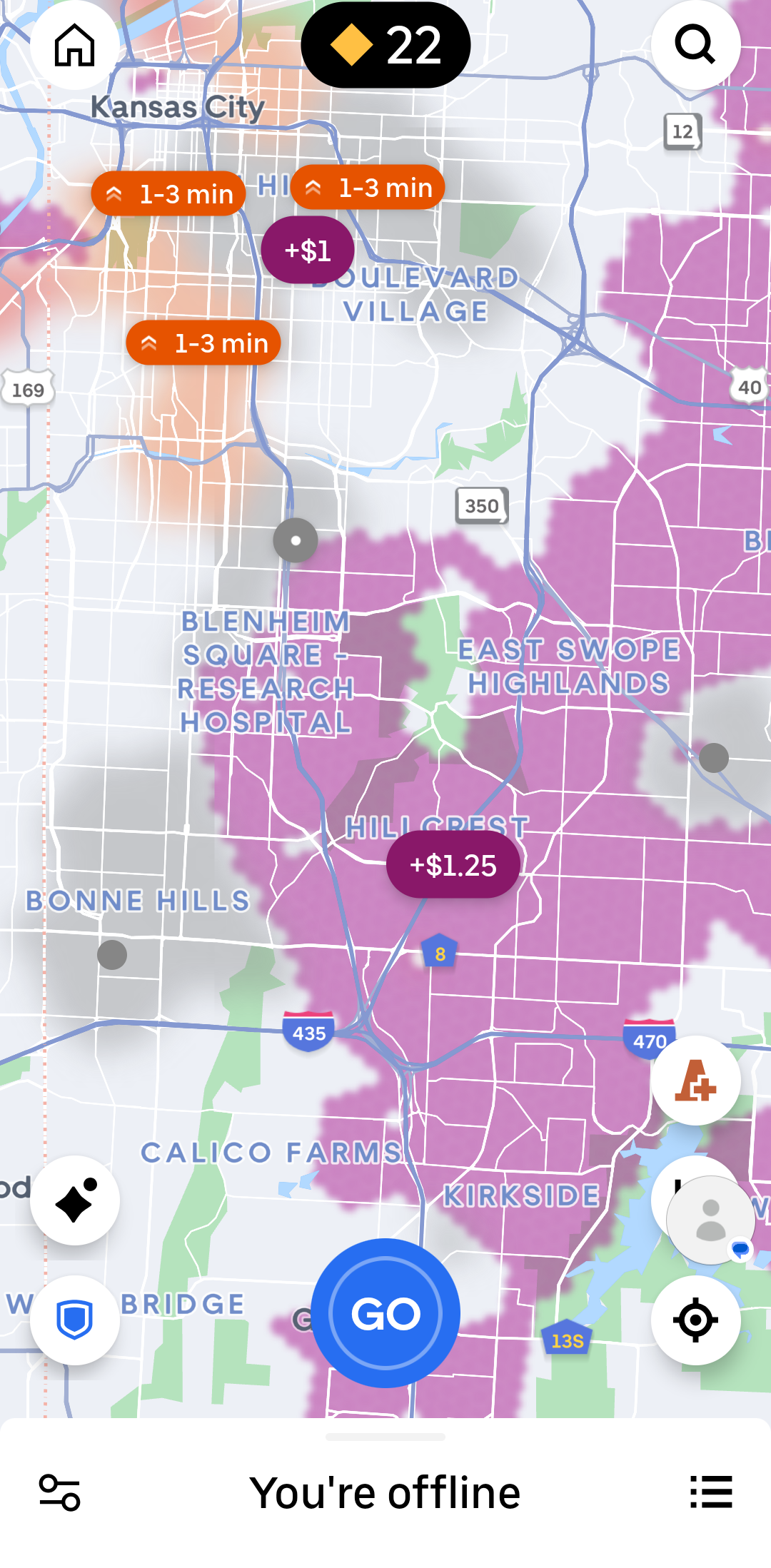
uber is shit.

you want me to turn on‽ Wtf

you don’t even pay $17/hour WITH a passenger.

Oh $1 surge. It’s so busy. If you had a decent base pay, one might opt to work, but you’re shit.

oh, yes, your actual pay varies. Yea, but you don’t have a decent base to base our day on. If I know an actual call is at least $25/hour, I might be ok with 40 minutes of down time, but I’m not wasting gas on a who knows if they’ll even give you minimum wage. I still have to buy gas and maintain my vehicle.

Posted in Uncategorized | Tagged , , | Leave a comment

Late Nights

Ever notice things are closed late at night lately?

We really need to change that.

Maybe a tax holiday from 10/11 pm till 4 or 5 am?

Do people just think it’s not safe? Of course, that’s a self-fulfilling prophecy. There’s a thing called Natural Surveillance. When there are things to do, there are eyes out there preventing crime. In the absence of acceptable things to do, crime fills the void, and the “Nothing good happens after midnight” becomes true.

A tax holiday is definitely cheaper than hiring more cops and adding pricey security options. Often, with crime, vandalism, and break-ins still happening as they chase the results instead of preventing the crime. Thus, we just end up paying twice. Once for the security, and again for the repairs and replacement of things stolen or damaged in the crime sprees.

Natural surveillance is a term used in crime prevention through environmental design models for crime prevention. Natural surveillance limits the opportunity for crime by taking steps to increase the perception that people can be seen. Natural surveillance occurs by designing the placement of physical features, activities and people in such a way as to maximize visibility and foster positive social interaction

See More: Wikipedia: Natural Surveillance

https://www.facebook.com/reel/1115617430160592

Posted in Uncategorized | Leave a comment

Definition reminder: State’s Congress

I am always forgetting what to call the representatives on the state levels. I’m like congressmen. Ok, that’s sexist? So, based on the names below. its “Legislature Members” or members of “their legislature”

Now, I remember why I frequently forget; there is no unified term for many. Here is the unified name for the state senates & house.

  • State Assembly – California, which is false. That’s their name for their House (Lower House)
  • State Legislature – Most other states
  • State Congress – Some states? Nope none!
  • Oh that’s wrong:
    • General Assembly
    • Legislative Assembly
    • General Court

Conclusion:

Its called:

  • State Legislature in 30 states with
    • Upper House: The State Senate (100% of states)
    • Lower House: House of Representatives (41 states)
      Nebraska doesn’t separate into Upper/Lower Houses (Senate only or Legislature only)

As a reference: Ballotpedia’s: Official names of state legislatures
(Archive: pdf capture 3/2026)
NOTE: Archive.org shows it essentially unchanged 2013-2026
{Nebraska was changed from Senate/none to just State Legislature }

Posted in Uncategorized | Leave a comment

Cash in King : Doesn’t mean what you think it does

Or does it?

Does it matter?

I was told to look it up when I mentioned that cash is king in regard to using a cc vs cash.

My response:

Technically, it kinda does. Debt Cards are more liquid than a Credit card. (P.s. So is Cash)

Debt Card Fees are lower.

Thus, pretty close on that side [with regard to retail], but a typical common usage has taken over on the street. -ish.

The ish: Cash is king will also mean the person here first with payment (Payment is liquid to the dealer, but for them, that liquidity is coming from their payment processor… yet, again, cash in hand vs the guy they’re holding the loan for over the weekend IS STILL KING. A dealer is guessing that their loan holding company will accept your application. They have up to 5 days or so to decline to buy the loan from the dealer.

In fact, the dealer can take the car back in that first 5-10 days if they can’t sell your debt.

SO, yes, liquid cash is king, and tangible cash is the MOST LIQUID.

Conclusion: the colloquial/common usage is essentially the accepted meaning in much of the American-speaking world. Remember, English is a fluid and ever-changing language. Knowing its history is good, and I would argue that its historical & financial-world usage IS in line with the common less formal usage.

The post:

From: FB, Bananas for scale post by Alex Whitney March 7, 2026 2:12 PM  ·
“The financial system has been broken for years. This is the “exact change” we need.”

My response is to:

Google “cash is king origin”, you’d be surprised to learn it doesn’t mean that notes and coins is better than card…

Lewis Farley
Posted in Uncategorized | Leave a comment

Lower Case unix

“unix” not Unix because of the “Unix Like” systems. Not everything IS “UNIX.”

But what about POSIX?

POSIX

POSIX: A Family of IEEE standards for compatibility between operating systems

posix.opengroup.org

The Portable Operating System Interface is a family of standards specified by the IEEE Computer Society for maintaining compatibility between operating systems. In order to define a level of compatibility, POSIX specifies many aspects of functionality that can be classified as application programming interface, command-line shell, and shell commands. Originally derived from commonly-found Unix APIs, shells, and commands, today many systems conform to the standard – including branded Unix systems, Unix-like systems, and many systems that were historically unrelated to Unix Continued in Wikipedia

Year started1988
Latest versionIEEE Std 1003.1-2024, 2024

It is unix as in how Klenix, Google, Coke, Band-Aide, etc., both brand names and colloquial or common usage.

This phenomenon is called genericization, where a brand name becomes synonymous with a general class of products, often losing its trademark protection. Examples include “Kleenex” for tissues and “Aspirin” for pain relievers.

Wikipedia (Also see Wiktionary or similar)

However, today, after writing this, nothing looks right.

Posted in Uncategorized | Leave a comment

OneCommander review by me

No paragraph yet. This is just a checklist of things I am finding out after installing

First week thoughts: 3 days in but only used one day because its such a shitty program

  • YAY! = Love it
  • Eh! = Take it or leave it (Fluf) Possibly A great feature in some “Niche” cases.
  • CON! = Negative. Please address and fix!
  • Negative Experience: Great option for some, but come on, there’s another potentially better option. Maybe created because someone is used to a Mac?
  • YAY! – It does offer the ability to lock folders to the top.!!!
  • Eh! – It does give the age since last use. Cool, but distracting? It needs a toggle. (Yes, I can change the skin or the column settings, but the columns we can pick are super minimal. (Another Miss for below?) It can be great when cleaning up, so a YAY, just address other things vs let this be the only thing I might use the app for when you claim there’s more to the app)

What I miss:

  • CON: the carrots that did exist in the left column
  • CON: the visibility: when selecting multiple items to move/copy, if you skip some, i.e., use the Ctrl instead of Shift to select, you don’t know which item you’re on until you select it.
  • CON: Star ratings
    (The author says they will eventually fix this. 9 months ago: June 2025 > March 2026)
  • CON!!!: the ability to access android devises. First, USB, second, I guess FTP, in which case the author says they will never support accessing those devices (FTP, or Android over FTP; or Android at all? I can see the USB drive, I just can’t do anything.)

Notable: In some aspects, this is just a skin. Which is fine, given that the author/programmer is already lacking in key features. It still uses the Windows “About Dialog,” which provides access to additional information, including tags/keywords, star ratings, permissions, etc. More Skin Things: The move or copy pulls up the windows move command. Which at least has decent (Good?) duplication/overwrite checks.

Speaking to my goals:

  •  Negative experience: The top-level carrots (Computer>C>Users>User>Documents> Category>Destination folder) in the left column, going down 4-5 directory levels, you still have to do that, but you use an upper window pane to do that. Sure, in the left column, you can add a single “bookmark” (my term) for each folder you want to access, but that’s silly when you could just use carrots. Thus, the NOT ADDRESSED carrot issue. (Created because someone was used to Mac’s?
  • CON: Carrots non-existent! I think they are non-existent because the software, programmer, or programming language can’t support them. Even the above-mentioned upper window pane opens a new column for each and every directory level you open. Such a mess! Granted, that only controls the current directory listed in the window pane below!!! Yes, at least you can copy/move a file from the lower window pane to one of the higher-level directories above, BUT if you want to move to a spot in a different tree, you must use a Miller Column.
  • CON: Forced Miller Columns: I understand many love them, and they’re a GREAT OPTION, but to be forced to use them when there are so many equally good options. i.e., the above mentioned Carrots in the left column.
    • Created because someone is used to a Mac?
    • Created because some unix / ftp / other file managers use it.
      PRO: Yes, its GREAT for viewing an entire folder, vs a disappearing tab or a dedicated 2nd window. VS. just seeing a list of columns in a carrot.
      (i.e., What actual files are in that particular folder)


First day:

CON: Left Column is just a link to the listed item. i.e. Grabbing a file and hovering over pinned directories in the left column doesn’t cascade open them. I guess I need to learn the Mac’s Miller Column feature, or get used to operating in two-column mode (The left column isn’t cutting it, and is one thing I didn’t like about half the modules in that left column on the MS Windows Explorer. I LOVE carrots’; the cascading directories feature)

It freaks out when working with a phone via USB. The Phone’s USB doesn’t like doing multiple things at once. From moving to renaming files, they all fail. Yes, copying/moving seems to use the window’s commands, but OneCommander must not be releasing control so that the command can be executed. Switching to Windows doesn’t work unless I fully release by closing the app. — known issue…

Cannot access Android device connected via USB or FTP, and FTP will never be added, as the developer has clarified that this feature will never be added. Unsure whether that “Never” includes USB.

The select multiple does not highlight the cursor line very well. I can see the selected items, but not the highlighted items. i.e. I use shift to select 3 items, then, when I switch to ctl to skip a few items, I can’t tell where I am until I hit the space bar to select the items.

Posted in Uncategorized | Leave a comment